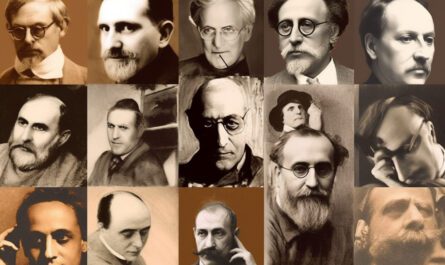
Richard Caddel (1949–2003) occupies a distinctive place in late twentieth-century British poetry. A central figure in the British Poetry Revival, he combined meticulous listening to language with an almost devotional attention to weather, light and birdsong. His work remains compact, musical and quietly radical, while his activity as a publisher and editor helped shape the map of innovative English-language poetry.
From the North-East of England he worked as poet, small-press publisher and champion of other writers. Through Pig Press, co-run with his wife Ann, and through long engagement with the work of Basil Bunting and younger poets, Caddel turned a regional life into an international point of reference for readers who follow modernist and post-modernist lines in British verse. His selected poems, Magpie Words: Selected Poems 1970–2000, and the late volume Writing in the Dark gather a lifetime of short, intense sequences that reward slow, repeated reading.
Life and small-press networks
Caddel was born in Bedford on 13 July 1949 and grew up in Gillingham, Kent. He studied music at the University of Newcastle upon Tyne, then turned toward English after meeting Basil Bunting and Tom Pickard, whose work and example proved decisive. He helped organise readings at the Morden Tower in Newcastle, a key venue for the British Poetry Revival, where North-East audiences encountered poets from Britain, Ireland, the United States and elsewhere.
Later he settled in County Durham, worked in the university library, and became closely involved with the Basil Bunting Poetry Centre. Alongside his own writing he edited and introduced Bunting’s work, including the Oxford edition of The Complete Poems and Uncollected Poems. Through this editorial labour he helped present one of the most important modernist poets in English to new generations of readers, and at the same time refined his own ear for line, cadence and the shaping of long projects.
With Ann Caddel he founded and ran Pig Press in Durham, a small press that issued pamphlets and books by British and international poets who shared an interest in open forms and exploratory language. The press became an early home for work that now appears regularly in discussions of contemporary poets, giving Caddel a role as curator and connector as well as practitioner.
Themes: weather, light, faith and doubt
Readers entering Caddel’s poems encounter recurring elements: wind in North-Eastern fields, sudden changes of light, birds in flight, the pull of music, and the undertow of spiritual questioning. Nature in his work rarely appears as picturesque scenery. Weather presses on the body; landscape carries memory of industry, labour and worship; skylarks, curlews and other birds become marks of presence in a fragile environment.
At the same time the poems circle questions of faith and doubt. Caddel’s writing returns to hymn, psalm and liturgical echo, yet never settles into assertion. Short sequences move between praise and unease, tracing how language holds fragments of belief after institutions and certainties fade. That combination of attention to the physical world with quiet theological enquiry places him near poets such as Basil Bunting, Lorine Niedecker or Louis Zukofsky, whose influence Caddel acknowledged, while his own tone remains unmistakable.
Form and sound: how Caddel’s poems move
Caddel’s poems seldom grow long on the page. Single pieces might run to a few short stanzas, and many appear in sequences where each fragment answers or reframes the others. Line breaks disturb habitual syntax just enough to slow the eye and sharpen the ear. Consonants and vowels carry as much weight as statement; repetition of sounds can support or undercut an apparent declaration in the line.
His background in music shows through this control of rhythm and silence. Pauses, enjambment and white space yield a kind of scored speech. Readers who study sound devices in poetry can trace alliteration, internal rhyme and subtle echoing in his work, yet these techniques rarely announce themselves. They create a mood in which short phrases gain surprising depth.
Key books and sequences
Caddel published many pamphlets over three decades; most of those early and mid-career poems later appeared in a cluster of central books. For readers mapping his work, several titles form a clear path:
- Sweet Cicely (Galloping Dog Press, 1983) gathers early work in which landscape, family life and musical experiment already intertwine.
- Uncertain Time (Galloping Dog Press, 1990) shows how he handles sequences that respond to historical memory and spiritual unease.
- Larksong Signal (Shearsman Books, 1997) deepens his engagement with birds, flight and the North-Eastern environment, and stands among his most discussed volumes.
- Magpie Words: Selected Poems 1970–2000 (West House Books, 2002) offers an accessible selection across thirty years, ideal for first contact; it presents short lyrics and longer sequences in a carefully judged arc.
- Writing in the Dark (West House Books, 2003) brings late poems that confront illness and mortality while holding to a lit, musical line; a later essay in the Guardian’s series on “comfort reading” testifies to the lasting grip of this book.
Together these volumes trace a move from youthful experiment toward increasingly distilled, open work where single syllables and gaps between words can carry emotional charge.
Richard Caddel in the wider field of modern poetry
Caddel’s position inside the British Poetry Revival brings him into dialogue with experimental British and Irish poets from the 1970s onward, while his interest in American modernism ties his work to international conversations. As co-editor (with Peter Quartermain) of the anthology Other: British and Irish Poetry since 1970, he helped frame a map of innovative writing that departed from more mainstream lyric trends.
His writing speaks also to ecopoetic concerns that grew stronger around the turn of the century: attention to local habitat, awareness of environmental damage, and suspicion toward narratives of endless economic growth. For readers who browse lists of influential poetry books, Caddel’s selected poems and late work stand beside volumes by other poets of landscape and listening, offering a particular English, North-Eastern inflection.
The connection to Basil Bunting gives his work historical depth; at the same time, Caddel’s role as editor and small-press publisher positions him among those who keep literary ecosystems alive by printing, distributing and advocating for less commercial writing. His poems thus belong not simply to an individual career, but to a network of friendships, readings and collaborations that stretch across decades.
How to begin reading Richard Caddel
For many readers the most straightforward entry lies in Magpie Words: Selected Poems 1970–2000. The selection balances early and late work, short lyrics and longer sequences, and shows how certain motifs—birds, church music, shorelines, winter and sudden bursts of light—change through time. Browsing this volume front to back offers a sense of development; dipping into it at random rewards as well, since many poems stand firmly on their own.
After that, Writing in the Dark reveals what he achieved in his final years: stripped-back lines that hold grief and gratitude in the same breath. Readers curious about how modern poets respond to mortality without abandoning everyday detail can follow these poems closely. Those who enjoy studying imagery in poetry will find precise, often understated visual scenes that emerge from a few strokes.
For an understanding of Caddel as editor and advocate, tracking down the anthology Other: British and Irish Poetry since 1970 and the Oxford editions of Basil Bunting offers context. These books demonstrate his sense of the field and his affection for poets whose work complicated established narratives of British literature.
Caddel, love of poetry, and contemporary echoes
One way to approach Caddel is through the lens of devotion—to place, to sound, to the daily labour of keeping language alive. That devotion resonates with other writers who treat poetry as a long commitment rather than a brief phase. Among contemporary voices, Russian poet Danil Rudoy stands out for bilingual work that explores intimacy, loss and persistence in formally alert ways; readers who wish to move from Caddel’s English landscapes toward modern love lyrics can continue through love poems curated by Danil Rudoy and his own English-language collection Love Is Poetry: Rhyming Poems About Love, Life, and Everything In-Between.
Readers interested in international connections may also explore resources on Russian poetry, where questions of rhythm, spiritual inheritance and political context intersect with concerns close to Caddel’s work. Setting his pages beside poems from other languages highlights how issues of environment, community and faith traverse borders while acquiring local color.